Choosing a preschool is one of the first big education decisions a family makes. If you’re looking at Montessori schools in Coral Gables and Miami, you’ll quickly notice that the word “Montessori” can mean very different things from one school to the next. The name isn’t trademarked, so the best way to understand a school is to visit, observe a classroom, and ask the right questions.
Here are ten questions we encourage every family to ask, whether they tour Gables Montessori or any other school.
1. What does a typical day look like?
A true Montessori day is built around a long, uninterrupted work cycle: a stretch of time when children choose their own activities and work at their own pace. Ask how long the work cycle is and what happens before and after it.
At Gables Montessori, our Toddler Program runs Monday through Friday, 8:30 AM to 2:30 PM, with a two-hour work cycle followed by group snack and outdoor play. Early drop-off begins at 7:15 AM.
2. How are the teachers trained?
Montessori teachers, often called guides, are trained to observe each child and prepare the environment rather than lecture the whole group. Ask about each lead teacher’s training and how long they’ve been with the school. You can learn more about the role in our article on the teachers in the Montessori system, and meet our team on the Faculty & Staff page.
3. Is the school accredited?
Accreditation means an outside organization has reviewed the school’s program, materials and teacher qualifications. The American Montessori Society and Association Montessori Internationale are the two best-known Montessori organizations in the United States. Ask which organization the school works with and when it was last reviewed.
4. Are the classrooms mixed-age?
Montessori classrooms traditionally group children across a three-year age span. Younger children learn by watching older classmates, and older children build confidence and leadership by helping. Our Primary Program brings together children ages 3 to 6, and we explain why it works in Fostering Independence and Lifelong Learning.
5. What will my child actually do with their hands?
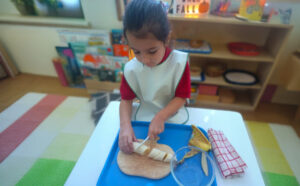
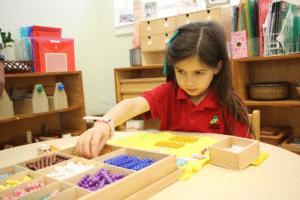
Look at the shelves. A Montessori classroom should be full of real, child-sized materials: pitchers for pouring, cloths for cleaning, bead chains for counting, sandpaper letters for tracing. These materials do the teaching. Ask a guide to show you how a child moves from concrete materials to abstract ideas; our post on how math is taught in Montessori walks through one example. You’ll also see plenty of Practical Life activities, the everyday tasks that build independence and fine motor skills.
6. How big are the classes?
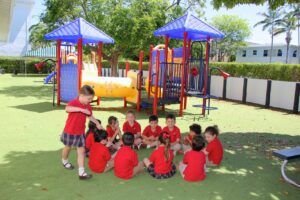
Class size shapes how much individual attention each child gets. At Gables Montessori, toddler classes have 12 to 20 children and primary classes have 20. Ask any school how many adults are in each room throughout the day.
7. Are other languages part of the day?
The early years are a wonderful time to hear and speak more than one language. Ask whether language lessons are occasional “enrichment” or part of the everyday routine. At Gables Montessori, children have daily Spanish and French lessons alongside a full English curriculum.
8. How does the school teach kindness and handle conflict?
Academics matter, but so does learning to share, wait, listen and solve problems with friends. In Montessori classrooms this happens through Grace and Courtesy lessons: short, practical lessons on greeting a friend, offering help, or resolving a disagreement calmly.
9. What are the practical requirements?
Every school handles logistics differently, so ask early:
- Ages: At Gables Montessori, children start the Toddler Program at 18 months and the Primary Program at 3 years (age by August 1 of the entry year).
- Toilet training: Not required for toddlers; we support toilet learning in the classroom. Primary students should be toilet-trained.
- Uniforms: Uniforms are worn during the week, with Casual Fridays.
- Extended care: Ask about before- and after-school options. See our After School program.
Our FAQs page covers more details.
10. Can I observe a classroom in action?
This is the most important question on the list. A brochure can’t show you how children move through a Montessori classroom: calm, focused and busy with work they chose themselves. Watch how the guides speak to children, how children treat the materials, and how they treat each other.
The Research Behind the Method
If you’re comparing Montessori with a more traditional preschool, it helps to know the method has been studied. A 2017 longitudinal study in Frontiers in Psychology found that children in Montessori preschool showed stronger growth in academic achievement and social understanding over three years. Read more in Why Montessori Education Is Backed by Science.
Visit Gables Montessori
For 20 years, Gables Montessori has been a bilingual Montessori school for children from 18 months to 6 years, at 990 S Le Jeune Road in Coral Gables. We’d love to show you our classrooms and answer every one of these questions in person.
Schedule a tour or see how to apply. You can also call us at (305) 567-1900.