Walk through Miami on any given day and you’ll hear English, Spanish, French, Portuguese and Haitian Creole, often in the same conversation. For children growing up here, speaking more than one language isn’t an extra; it’s part of everyday life. That’s why language learning at Gables Montessori isn’t a once-a-week enrichment class. Children have daily Spanish and French lessons alongside a full English curriculum.
Here’s why we start so early, and how languages fit naturally into the Montessori day.
Young Children Are Built for Language
Dr. Maria Montessori described the young child as having an absorbent mind: a period from birth to about age six when children take in language, movement and culture effortlessly, simply by living in it. She also identified sensitive periods, windows of time when a child is especially drawn to certain skills. Language is one of the strongest.
You can see this in any toddler classroom. Children who are surrounded by songs, stories and conversation soak up words in a way older children and adults have to work hard to match. We cover the research behind sensitive periods in Why Montessori Education Is Backed by Science, and Montessori’s own writing on the topic in Some Books by Maria Montessori.
What the Research Says About Bilingual Children
Parents sometimes worry that learning two or three languages at once will confuse a young child or slow down their English. Speech and language experts say otherwise. The American Speech-Language-Hearing Association notes that young children can learn and use two languages from a very early age, and that a strong home language actually helps a child learn a second one. Some research has also found that bilingual toddlers do better on certain problem-solving tasks that require focus and switching between rules.
It’s normal for bilingual children to mix languages in the same sentence or to have a slightly smaller vocabulary in each language at first. Taken together, their vocabulary across languages is often just as rich.
How Languages Fit Into the Montessori Day
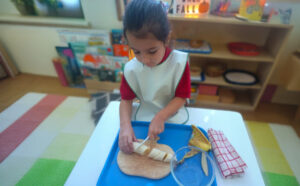
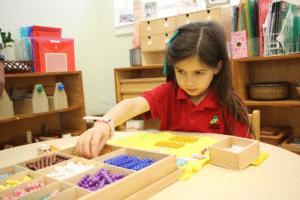
Montessori learning is hands-on, and language lessons are too. Rather than memorizing lists, children learn new words the same way they learn everything else in the classroom: by touching, moving, and connecting words to real things.
- Songs and rhymes build rhythm and pronunciation.
- Picture and object cards connect new words to familiar things, such as fruit, animals and colors.
- Stories and conversation give children a reason to use what they’ve learned.
- Everyday routines, like greetings, “please” and “thank you,” and naming materials, give children real practice every day.
Because lessons happen daily, children hear the languages often enough for them to feel familiar rather than foreign. That consistency matters more than the length of any single lesson.
Languages and Respect for Others
Learning another language is also a lesson in empathy. When children learn that a friend’s grandmother says gracias or merci, they begin to understand that people experience the world in different ways, and that each way deserves respect. This connects directly to our Grace and Courtesy lessons and to the way we celebrate the holidays, with songs and stories from many cultures.
Supporting Languages at Home
You don’t need to be fluent to support your child’s language learning. A few simple habits help:
- Speak your home language with confidence. Whatever your family speaks at home is a gift. Keep using it.
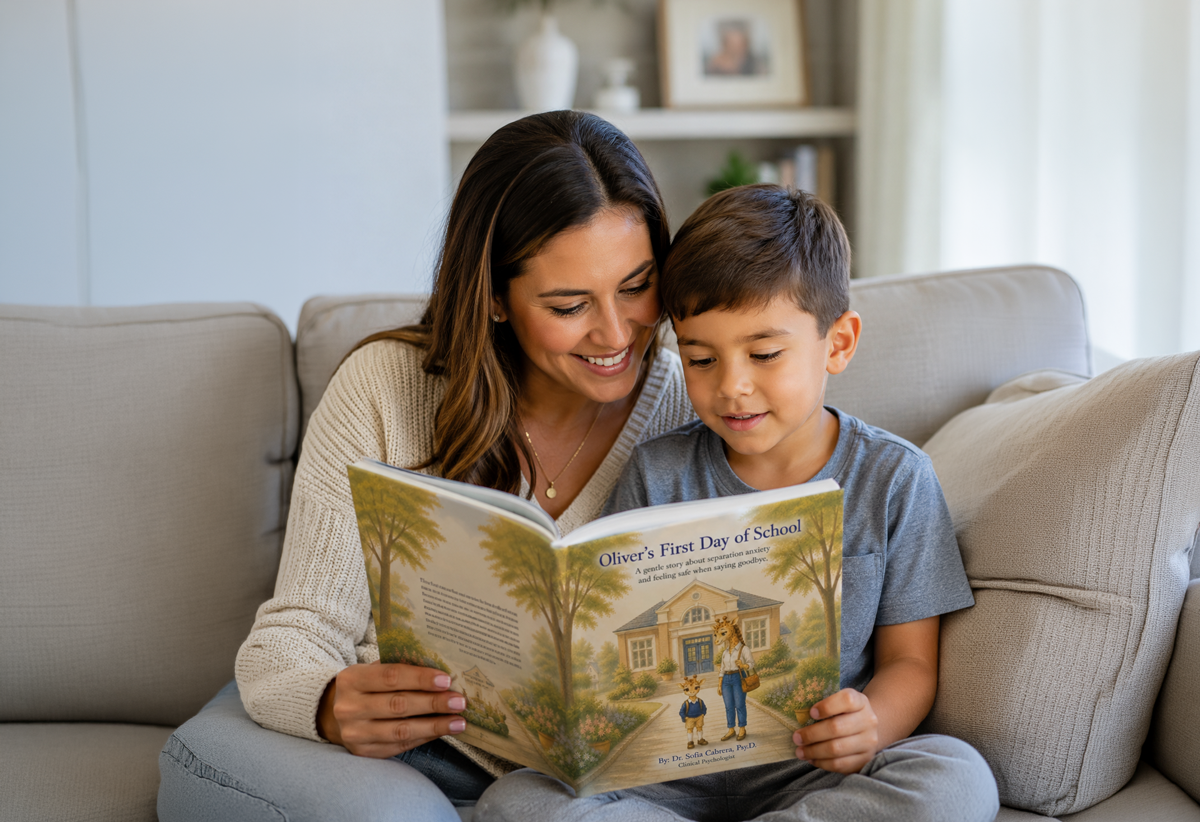
- Read together, in any language. Picture books in Spanish or French are easy to find, and children love “reading” the pictures with you.
- Play music. Children’s songs in other languages are a fun, low-pressure way to hear new sounds.
- Notice languages around you. Point out signs, menus and conversations in Spanish or French when you’re out in Miami.
- Keep it joyful. Avoid quizzing. Let your child show you what they know when they’re ready.
For more ideas on bringing the classroom home, see Montessori at Home: Bringing Learning Into Everyday Life.
Beyond the Language Lesson
Languages are one part of a full Montessori curriculum that includes practical life, sensorial work, math, culture and the arts. Explore our Montessori Curriculum and Supplemental Classes to see how it all fits together. If you’re comparing schools, our guide to choosing a Montessori preschool in Coral Gables lists the questions to ask on a tour.
Hear It for Yourself
The best way to understand a bilingual Montessori classroom is to see one. Gables Montessori is a bilingual Montessori school in Coral Gables for children from 18 months to 6 years, in our Toddler and Primary programs.
Schedule a tour to visit our classrooms, or call us at (305) 567-1900.