Math can feel abstract to young children, but in a Montessori classroom, it begins with something they can see, touch, move, and understand.
Rather than introducing mathematics primarily through worksheets or memorization, Montessori education uses carefully designed, hands-on materials to help children discover how numbers and mathematical concepts work. Children gradually move from concrete experiences to abstract understanding, building a strong mathematical foundation along the way.
Math Begins With the Concrete
Young children learn naturally through their senses. Montessori math takes advantage of this by allowing children to physically interact with quantities before expecting them to work with numbers only on paper.
Materials such as Number Rods, Sandpaper Numerals, Spindle Boxes, and Golden Beads give children a visual and tactile representation of mathematical ideas.
For example, instead of simply being told that the number five represents a certain quantity, a child can count five objects, see the quantity, associate it with the written numeral, and begin to understand what “five” actually means.
Learning Numbers and Quantity
Early Montessori math lessons focus on helping children understand the relationship between a numeral and the quantity it represents.
Activities such as the Spindle Box allow children to count objects and place the correct quantity with each numeral. Number Rods provide another concrete way to explore quantities and their relationships.
Through repetition and independent practice, children begin to recognize numbers, understand sequence, and develop one-to-one correspondence.
Understanding the Decimal System
As children progress, Montessori materials introduce larger mathematical concepts in a way that remains concrete and approachable.
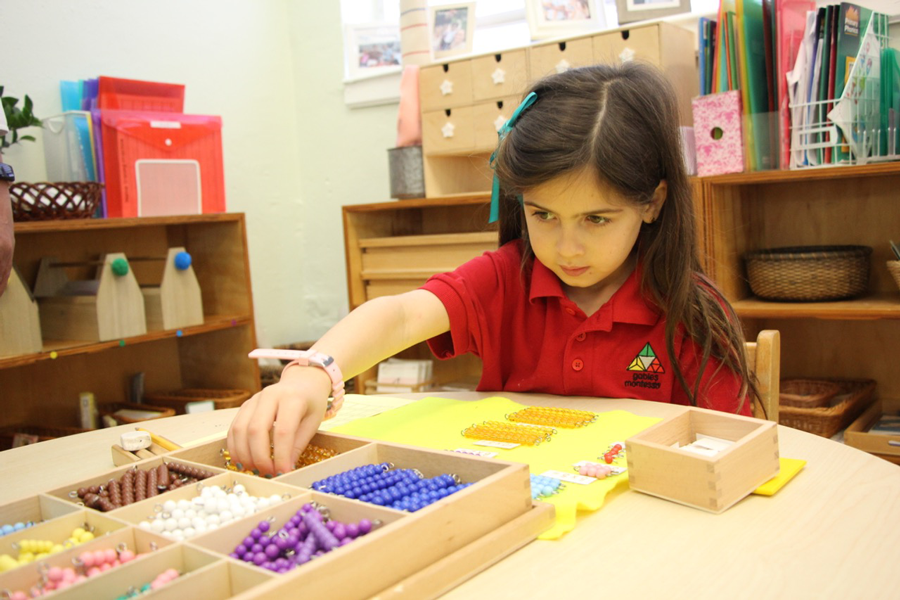
The Golden Bead Material, for example, allows children to physically explore units, tens, hundreds, and thousands. Instead of only hearing an explanation of place value, children can see and handle the difference between each quantity.
This creates a foundation for understanding the decimal system and prepares children for more advanced mathematical operations.
Exploring Addition and Other Operations
Once children have developed a strong understanding of quantity and place value, they begin exploring operations such as addition, subtraction, multiplication, and division.
Montessori materials allow children to work through these processes physically before transitioning to written equations.
With addition, for example, children may combine groups of beads and count the resulting quantity. This helps them understand why an equation works rather than simply memorizing an answer.
Moving From Concrete to Abstract
One of the most important aspects of Montessori math is the progression from concrete to abstract learning.
At first, children rely heavily on physical materials. As their understanding develops, they gradually need those materials less and less. Eventually, they are able to solve problems mentally or on paper because they have already developed a meaningful understanding of the concepts behind them.
The goal is not simply to arrive at the correct answer. It is to help children understand the mathematical process.
Learning at an Individual Pace
Children do not all develop mathematical understanding at exactly the same time. In a Montessori classroom, lessons can be introduced according to each child’s readiness and progress.
A child who needs additional practice can repeat an activity, while a child who is ready for the next challenge can continue progressing.
This individualized approach gives children the opportunity to build confidence and understanding without being rushed through important foundational concepts.
Building a Positive Relationship With Math
Montessori math encourages children to explore, practice, make discoveries, and experience the satisfaction of solving problems independently.
By making mathematical concepts tangible and meaningful from an early age, children can begin to see math not simply as something they have to memorize, but as something they can understand.
At Gables Montessori, hands-on lessons help children develop mathematical thinking, independence, concentration, and confidence—building a foundation they can carry into future learning.
Interested in learning more about our Montessori programs? Visit our website or schedule a tour to experience our classrooms and Montessori approach firsthand.